





“Legacy can give you a platform. What you build on it is still your responsibility.”
Ankit Aditya has never been particularly interested in staying inside one box.
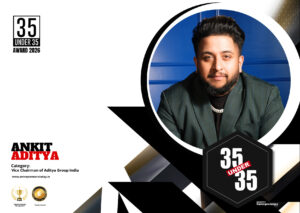
As Vice Chairman and Chief Innovation Officer of Aditya Group, he is part of a family enterprise established in 1984 that today employs approximately 1,200 people, with its education network serving more than 13,000 students.
It is a significant platform. But Ankit is equally interested in what does not yet exist.
His work now stretches across design and construction, media, brand building, sport, commerce, education and artificial intelligence. For him, these are not disconnected pursuits. They are different expressions of the same instinct: to build, experiment and find better ways of doing things.
His journey is therefore not simply about stepping into an established family business. It is about respecting an inheritance while building an identity of his own.
A Legacy—and a Question
Growing up around entrepreneurship gave Ankit an early understanding of what it takes to build an institution. He watched his father, the late Bhaskar Aditya, create businesses and educational institutions that became part of the city’s landscape.
The lesson he carried forward was that institutions have to outlive individuals.
But that also raised a question familiar to many next-generation entrepreneurs: What part of the story will actually be mine?
Ankit does not deny the advantages of the foundation he inherited. He distinguishes access from accomplishment.
“A family name can give you opportunity and perspective,” he says. “But credibility is different. That has to be earned through what you build and how you perform.”
That search for an identity of his own eventually took him beyond conventional business.
Before Business, There Was Storytelling
Ankit studied Sound Engineering and Film Production in London.
At first glance, it may seem an unusual path for someone who would later occupy a leadership role within a diversified business group. In hindsight, it explains much of his approach.
Sound trained him to notice atmosphere. Film taught him narrative. Production taught him that creativity ultimately has to survive deadlines, budgets, people and execution.
Those lessons became transferable.
A restaurant could tell a story. A school could become an experience. A brand could have character. A sporting environment could create belonging. Technology could be designed around human behaviour rather than functionality alone.
“Film made me observe people differently,” he says. “You start thinking about emotion, timing, movement and experience. Eventually I realised that business isn’t really disconnected from any of that.”
Building, Literally
One of the clearest expressions of that independent thinking is Grandly Designers & Contractors, co-founded with Roshne Aditya.
Grandly was built around a straightforward idea: creative concepts and their physical execution should not have to exist in separate worlds.
The company evolved beyond the traditional design-studio model into an integrated practice spanning concept development, technical design, project planning, procurement, contracting and execution across residential, commercial and hospitality environments.
By its fifth year, Grandly had recorded approximately ₹100 crore in turnover.
For Ankit, the number matters less than what it demonstrates: that a creative practice can become a serious, scalable enterprise without losing its character.
“Beautiful ideas are easy to admire on a screen,” he says. “The difficult part is building them—with budgets, timelines, vendors, engineering and hundreds of decisions nobody will ever see.”
His background in cinema continues to influence how he approaches physical spaces. He thinks about light, material, acoustics, movement and reveal. To him, memorable spaces are not merely decorated. They are experienced.
With exposure to markets including London, Dubai and Bangkok, Grandly is now looking towards a broader multi-city Indian and international footprint.
Creativity as an Operating System
Grandly is only one expression of Ankit’s interests.
Through APE Studio, he has developed another platform around strategy, filmmaking, communication, media, content and brand building. His interests also extend into sport, commerce, education and technology.
Viewed individually, these might appear disconnected.
Ankit sees them differently.
They are different applications of the same operating system: curiosity, creativity and execution.
“I don’t really think in terms of industries,” he says. “I think about problems and possibilities. Sometimes the answer is design, sometimes technology, sometimes storytelling. The interesting part is finding the right combination.”
That cross-disciplinary approach has increasingly become central to how he thinks about entrepreneurship.
Reinventing from Within
The same thinking now shapes his work inside Aditya Group.
As Chief Innovation Officer, Ankit’s focus is not simply on attaching new technology to an established institution. It is on asking what can genuinely be improved.
Education is one of the biggest laboratories.
With more than 13,000 students within the wider ecosystem, he sees opportunities to rethink how artificial intelligence, financial literacy, gamification and personalised learning can interact with conventional education.
But he remains cautious about innovation performed for appearances.
“If AI is being used simply because everybody is talking about AI, I’m not interested,” he says. “It should solve something, improve something or make possible something that wasn’t possible before.”
That philosophy extends to AI-powered business systems, financial technology, decision-making and organisational productivity, alongside new ideas across media, consumer businesses and sport.
For Ankit, an established ecosystem can provide something startups often lack: real environments in which ideas can be tested. The challenge is being willing to question systems that already work.
The Founder Education Nobody Photographs
Entrepreneurship is usually documented through launches, awards and milestones. Ankit speaks just as readily about the parts that rarely make the photographs.
Delayed payments. Difficult projects. Wrong hires. Ideas that never became businesses. Cash-flow pressures. Decisions that looked brilliant until reality disagreed.
Those experiences changed his understanding of leadership.
In the early stages of a venture, founders are often rewarded for being involved in everything. Scale eventually punishes the same behaviour.
“Earlier, I thought being involved in everything meant I cared more,” he says. “At some point you realise you can actually become the bottleneck.”
The answer was structure: better financial controls, clearer accountability, stronger teams and specialists.
Most importantly, it meant learning when to let other people lead.
That transition—from being the person with the ideas to building an organisation capable of generating and executing ideas without the founder in every room—has become one of the defining lessons of his journey.
Ambition Requires Allies
Perhaps the biggest shift in Ankit’s thinking today is his understanding of scale.
For years, entrepreneurship was personal: build, prove, execute and repeat.
His ambitions now are larger.
“There was a phase when I felt I had to prove that I could build things myself,” he says. “I don’t think like that anymore. The future I want to build is too large for one person or one company.”
The next phase is therefore deliberately collaborative.
Ankit wants to work with founders, technologists, designers, researchers, investors, institutions and unconventional thinkers who bring capabilities he does not possess himself.
He is increasingly open to conversations with venture capital firms, family offices and strategic investors where capital is accompanied by intelligence, networks and long-term alignment.
For him, the right capital is not merely financial. It is catalytic.
The same openness applies to entrepreneurs and creators. He increasingly sees value in co-creating, incubating, partnering, investing and building joint ventures around exceptional ideas and capable people.
The objective is not necessarily to own every opportunity.
It is to help build the right ones.
India to the World
There is also a broader international ambition emerging.
Ankit believes Indian creative and entrepreneurial organisations should not think of themselves only as domestic businesses. India can build global brands, technology, design practices, media properties, educational products and intellectual property capable of travelling across markets.
For Grandly, that means multi-city and international expansion.
For technology ventures, it means thinking globally from the beginning.
For media and creativity, it means telling Indian stories without limiting them to Indian audiences.
“I want to build from India without thinking small because we are in India,” Ankit says. “There is extraordinary talent here. The opportunity is to combine that talent with capital, design, technology and world-class execution.”
What Comes Next
The next decade will demand something different from Ankit Aditya than the previous one.
The first chapter was about discovery. The second was about proving that independent ideas could become functioning businesses.
The next will be about scale.
Scaling Grandly across cities and international markets. Building APE Studio into a broader creative and strategic platform. Applying artificial intelligence meaningfully across education and enterprise. Developing new ventures. Backing exceptional founders. Building partnerships with investors, governments and institutions.
But perhaps the most important evolution is personal.
Ankit is moving beyond the need to prove that he can build things himself.
He is increasingly focused on finding the right people to build much bigger things with.
“I’ve spent the first part of my journey proving to myself what I can build,” Ankit says. “The next part is about finding the right people to build much bigger things with.”