






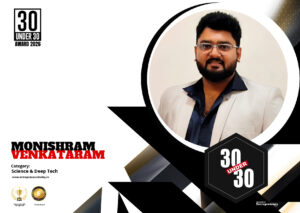
Recognised with a Young Scientist Award at just 14, Monish Ram built his first electric car at 18, marking the beginning of an extraordinary journey in engineering and innovation. He went on to spend five years contributing to India’s research and development ecosystem, working on emerging mobility technologies and advanced engineering solutions.
His professional journey has since taken him across Europe, the Middle East and Southeast Asia, collaborating on cutting-edge technologies and global engineering programmes.
An entrepreneur with a vision for sustainable technology, Monish founded Hydrium Energy, a deep-tech venture currently in its early stages, working towards enabling a renewable hydrogen-based energy economy for the future. Its ambition is to develop hydrogen technologies that can transform mobility, power generation and industrial applications.
Alongside his technology ventures, Monish is actively involved in his family’s 30-plus-year-old business dealing in heavy industrial products, focusing on modernisation, new opportunities and global expansion.
Currently pursuing a PhD in Robotics and Artificial Intelligence, he is also co-founding a deep-tech venture focused on advanced anti-crime and security technologies.
Beyond business and research, Monish is deeply passionate about motorsports, long-distance driving and riding, and overlanding. He is partnering with an overlanding and camping company, contributing to vehicle engineering, custom builds and technical development. He also has a personal passion for designing and building bespoke cars and motorcycles, creating unique machines tailored to individual clients.
Driven by curiosity and a passion for engineering, Monish continues to bring together technology, adventure, research and entrepreneurship, with a vision to build indigenous innovations and globally competitive businesses from India.
A Diverse Business Portfolio
Monish Ram’s entrepreneurial interests span technology consulting, manufacturing, and clean energy, with each venture reflecting a different role in his business journey.
As Chief Consultant at 2099 Future Solution, he works with global technology startups and Indian businesses on fundraising, investor outreach, and go-to-market strategies. Depending on the assignment, he either works directly with clients as an independent consultant or leads client engagement while his team handles project support.
His involvement in his family’s 35-year-old manufacturing and wholesale business takes a different direction. Rather than overseeing daily operations, Monish focuses on digital transformation, infrastructure upgrades, new product development, and identifying opportunities for growth. The business supplies mechanical and construction equipment and heavy materials across India.
In 2023, he founded Hydrium Energy, where he serves as CEO and leads the technology function. The company is developing green hydrogen-based power-generation technology for specialised ground and aerial vehicles where conventional battery charging may be impractical. Its approach combines a smaller battery component with on-demand power generation using green hydrogen produced through renewable energy. With operations in India, Hydrium Energy is now exploring expansion into the UAE and the US.
Monish sees this as a way to address the resource and manufacturing limitations of converting large numbers of commercial vehicles and heavy transport to conventional battery-electric systems. As Monish highlights,
“By reducing dependence on large battery packs and rare-earth materials, Hydrium’s technology is being developed around a different approach to electrification, using green hydrogen as the primary energy source.”
About Sakshya112
Monish’s other venture, Sakshya112, is a technology venture focused on bringing advanced monitoring, surveillance, and emergency-response technologies to India. The venture aims to adapt technological developments in Western markets for Indian emergency services, with an emphasis on improving location tracking, surveillance, and the ability to respond quickly when assistance is required.
Its offerings include indoor and outdoor drones with docking systems, as well as mobile vehicles equipped to locate and track in GPS-denied environments using Physical AI. The broader focus is on developing technology that can support monitoring and emergency operations even in situations where conventional GPS-based tracking may not be available.
A New Direction in Clean Energy
Hydrium Energy is developing hydrogen-based power solutions across multiple applications rather than limiting itself to electric vehicles. Its work spans gensets, drones, VTOLs, forklifts, port and warehouse equipment, and mining trucks, including tipper trucks. The broader objective is to build technology in India that can eventually serve international markets, particularly where there is demand for alternatives to fossil-fuel-powered systems.
“The company entered a relatively new market in India, with the country’s hydrogen mobility and related initiatives only beginning to take shape in the last two to three years.”
Monish explains that the competitive landscape remains relatively limited, particularly in mobility applications. He says several Indian competitors currently rely on technologies developed outside India, which can make their solutions 10 to 15 times more expensive. Others developing similar technology within India are focused mainly on stationary applications, while very few are working on mobility. This gives the company an advantage as it develops its technology while the market is still taking shape. Hydrium is therefore focused on localising the technology and reducing its cost significantly, with a target of bringing it down to one-tenth of the current cost.
Breaking Through Barriers
One of Monish’s biggest concerns has been navigating the paperwork and compliance involved in building a new technology company in India. Since he is working on an emerging technology, securing intellectual property and establishing the right collaborations has also been difficult. He believes the process of accessing funding, grants, and other support remains challenging and not always straightforward for entrepreneurs.
However, Monish had some existing industry relationships through his previous work with the Ministry of Heavy Industries and various industries across India, which helped him navigate some of these challenges. Even so, with those connections, building a new company and accessing the resources required to develop the technology remains a challenge.
The Milestones
Monish has previously worked with Force India Formula One as a junior driver. He later worked with high-performance automotive companies and served as the lead powertrain engineer for the latest three Bugatti vehicles, which are capable of speeds of more than 450 km/h.
For Monish, that experience has also shaped what he wants to contribute to the next generation of engineers. He wants to bring the technical knowledge, engineering practices, and training he gained through working on advanced automotive technologies to young people in India, particularly in areas that remain relatively underdeveloped in the country.
One of Monish’s early achievements came long before his entrepreneurial ventures, when he was recognised as a Young Scientist through a government-led initiative in 2011. His project focused on an auto theft tracking system using GPS and GPRS technology, allowing vehicles to be tracked and remotely controlled through a central system. The project won first place in the competition and earned him the Young Scientist recognition.
The work later became an important part of his journey. Monish went on to work at a government research institute where he was involved in testing such tracking modules, and later helped a UAE-based company develop similar vehicle-tracking technology.
He also says the concepts from his original thesis eventually became a foundation for standards and systems used for commercial vehicle tracking in India, including AIS 140, as well as the technology behind FASTag-related vehicle monitoring initiatives.
A Vision for the Future
Monish’s vision is to accelerate the shift away from fossil fuels by developing hydrogen-based technologies that can support a more sustainable energy future. He believes the world’s continued dependence on fossil fuels has created both environmental and geopolitical challenges, making the development of viable alternatives increasingly important. For him, hydrogen represents one of the potential solutions to reducing that dependence.
Over the next few decades, Monish wants to develop technologies that enable industries and mobility applications to operate with less reliance on fossil fuels. The fundamental priority for Hydrium Energy will be improving the efficiency of hydrogen-based power systems and making the technology more practical for real-world applications. His larger ambition is to contribute to a future where energy systems can operate without depending on fossil fuels.
His vision also extends to Sakshya112 with a broader objective of supporting faster monitoring, tracking, and emergency response through technologies that can function even when conventional GPS is unavailable.
Beyond individual ventures, Monish’s long-term plan is to build a diversified business group rather than remain focused on a single sector. He wants to develop his existing businesses into a more efficient conglomerate spanning energy, construction, artificial intelligence, robotics, defence technology, and consumer goods. Research is also underway in AI and robotics, with the ambition of developing technologies that can address industrial and national requirements. As he puts it,
“The larger ambition is to build a group with multiple businesses operating across sectors and markets, working alongside leading global and Indian business leaders while taking a more active role in shaping major industries in India and internationally.”
Words of Wisdom
Monish’s most important takeaway from his journey has been that entrepreneurship can only be shaped by risk-taking, intent, persistence, and the willingness to create your own opportunities for luck.
He also sees networking as a critical part of that process. Many of his career decisions have been driven by the opportunity to expand his network and create new possibilities.
As he signs off, his advice to aspiring entrepreneurs is,
“People often say that becoming rich or successful comes down to luck, but it does not work that way. It is about increasing your surface area for opportunities and the number of times you try. There will be failures, downturns, and lessons along the way, but you have to work hard and experiment with different approaches to increase your chances of success. At the end of the day, luck is still an important factor.”