






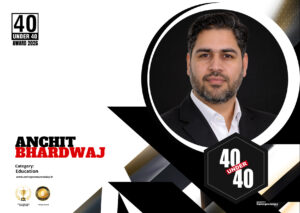
“Long-term vision must always outweigh short-term gain.”
Captain Anchit Bhardwaj has spent more than 18 years in aviation as a commercial pilot, trainer, and operator, flying Boeing 777 and 787 aircraft for a leading international airline and logging over 10,000 hours in the cockpit.
Throughout his career, Captain Anchit has gained deep exposure in aviation operations and training systems. It was through his experience across flight operations and training that he got exposed to the structural gaps that continue to limit the growth of India’s aviation ecosystem. That very insight led him to found Skynex Aero Private Limited, an integrated aviation company focused on strengthening domestic aviation infrastructure through an approved Flight Training Organisation (FTO) and Maintenance, Repair and Overhaul business, while also pursuing its NSOP (Non-Scheduled Operator Permit) to launch passenger services aimed at improving regional connectivity. In a freewheeling chat with Entrepreneurs Today, he says,
“In a short span, Skynex has scaled rapidly. Our Flight Academy is already among the largest in India, and by July/August 2026, we expect to become the largest in the country in terms of active flying training aircraft.”
True Calling
Captain Anchit Bhardwaj’s inspiration came from his own experience in aviation, where he saw India’s aviation industry expand rapidly. Reflecting on how it all began, he reveals,
“While the space expanded quickly, the supporting ecosystem for training, technical services, and manpower development lagged far behind.”
As a pilot, he noticed the country’s dependence on overseas training and imported services, and that gap became the basis for Skynex Aero. He set out to build an integrated aviation company in India that could deliver global-standard capabilities locally. He adds,
“We started Skynex Aero with a strong foundation in robust training systems, modern aircraft, disciplined processes, and a safety-first culture. Pilot training was our first step, because that is where the need was immediate, and the impact was tangible. From there, we expanded into MRO services, and now we are moving toward broader aviation solutions, including regional and remote connectivity for passengers.”
A Competitive Edge
What makes Skynex Aero unique is that it is building an aviation ecosystem, not just a flight school. The company combines quality, safety, scale, and self-reliance in a sector that has long been fragmented and dependent on external support.
At Skynex, they have some of the most advanced and well-maintained training aircraft found anywhere internationally. The airline-level instructors are highly experienced, with a key focus on structured instructor development.
The training and safety standards are part of the daily operations and are on par with international benchmarks. They also have a systems-driven training methodology rather than personality-driven operating habits and bring in-house capability across training, maintenance, and instructor creation, which improves reliability and reduces outside dependency.
With multiple training bases and continued investment in fleet, infrastructure, and process maturity, Skynex is designed to deliver a consistent, high-quality training experience for students across locations. Captain Anchit explains,
“This integrated structure gives us a major operational advantage. It allows us to control quality more effectively, scale with consistency, and deliver better outcomes for students and aviation customers alike.”
Rocky Road
For Skynex, the journey has been quite challenging, as building in aviation came with multiple challenges from the start.
Captain Anchit explains that the industry is heavily regulated, capital-intensive, and highly execution-dependent, so regulatory approvals, financing, and manpower are some of the initial challenges one has to deal with. He also acknowledges that, especially in India, the approval processes are painstakingly slow and stringent and demand patience and strict compliance. He adds,
“Access to financing has been another major challenge. Aviation assets such as aircraft are still not always treated optimally within lending structures, and Flight Training Organisations are not yet fully recognized in the same way as mainstream educational institutions. That creates friction in capital access, especially during growth phases.”
On top of that, the industry lacked enough skilled manpower to match the pace of demand. The industry was not even prepared to cater to the rise in demand when Skynex came in to address the gaps. Additionally, hiring and building the right team with specialised roles is expensive and time-consuming. Captain Anchit reflects,
“We overcame these challenges by staying disciplined and building long-term. We focused on strong regulatory compliance, formed the right strategic partnerships, explored alternative funding channels, and invested continuously in building our own talent pipeline. Instead of waiting for the ecosystem to catch up, we chose to create capability in-house and train for the future ourselves.”
Fruits of Labour
“Success is ultimately measured by the quality of people we produce and the trust we build in the industry.“
Today, Captain Anchit makes sure to measure his success by the quality of pilots Skynex produces and the trust it has built in the industry. Speaking of the vision, he notes,
“The goal is to produce disciplined, safety-conscious, operationally sound professionals who go on to perform well in the aviation sector.”
He is particularly proud that the company began with just three training aircraft in June 2022 and has grown to 32 aircraft, putting it on track to become India’s largest aviation training company by active operational training fleet by July or August 2026.
Captain Anchit has also been featured in ThePrint for its role in the Ukraine evacuation mission, in The Times of India for the storm landing story and the AAI MoU coverage.
Along the way, Skynex has also built one of the fastest-growing flight training organisations in the country. They have also established an integrated platform across pilot training and MRO services and have become a service center for a leading European engine manufacturer. The other milestones include developing MRO capability across most light aircraft types flown in India and securing what they believe is the fastest regulatory approval journey in Indian aviation history, moving from NOC to full FTO approval in just a matter of 11 months. Thoroughly, their commitment has been to an execution-focused culture, quality, reliability, and safety.
What Lies Ahead?
Skynex Aero’s future plans are currently focused on becoming one of Asia’s leading aviation training and services companies while strengthening India’s aviation ecosystem at every level. Captain Anchit highlights,
“We want to create a platform that contributes meaningfully to India’s aviation future, not just by training pilots but by strengthening the full ecosystem that supports aviation growth.”
Outlining the plans for the short term, he says the company will focus on expanding its fleet and training capacity. They will also set up additional training bases across India and integrate more advanced training technologies and simulation-led systems.
Another focus is on deepening global partnerships in training and technical services while expanding their domestic overhaul capability for engines and components. The vision is to launch regional connectivity services by the end of 2026, with the larger goal of building domestic capability that supports India’s aviation growth through training, maintenance, and air connectivity. Captain Anchit adds,
“India is one of the most important aviation growth markets in the world, and we want Skynex to play a defining role in that transformation, whether it is in the form of training, maintenance, or air connectivity.”
Words of Wisdom
Over the years, one of the biggest lessons that Captain Anchit has learned is that long-term vision must outweigh short-term gain, especially when it comes to a sector like aviation, where delays and uncertainty are part of the journey. He reflects,
“In a highly regulated sector like aviation, there will always be setbacks, delays, and moments of uncertainty. What matters is the ability to stay disciplined, stay resilient, and keep moving with integrity.”
Another key lesson he has learned is that founders have to keep evolving, since a business can only grow as fast as its leadership. He says it’s important to keep learning, making decisions, and being willing to act even when things even if it seems difficult, because it’s grit that truly drives success.
As he signs off, Captain Anchit leaves a key lesson for budding entrepreneurs. He emphasises,
“Execution matters more than excitement. A good idea is never enough on its own. What creates success is discipline, consistency, and the grit to keep going when things get difficult. Talent is valuable, but grit is often the real differentiator. An average idea executed exceptionally well will outperform a brilliant idea executed poorly. Build for the long term, stay honest in your work, and never stop learning.”