




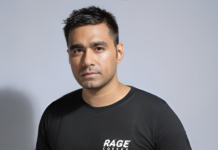


“Feeling productive and building value are two different things. In a kitchen, you’re judged by tonight’s service. As a founder, you’re judged by whether the company is stronger this quarter than the last.”
Hesham Sunesra is the founder of Cookie Cartel, a premium cookie brand specialising in chunky, gooey, stuffed New York-style cookies. Hesham built Cookie Cartel around a familiar product with a premium ambition. Drawing on his family’s hospitality business in Panchgani, he brought the idea to Mumbai through a cloud kitchen.
The business has since expanded to pan-India deliveries and secured ₹80 lakh for 12% equity on Shark Tank India Season 5, with backing from Anupam Mittal, Kanika Tekriwal and Vineeta Singh.
An Untapped Premium Dessert Market
Hesham saw a gap in a market where cookies often played a supporting role. Bakeries sold them alongside other products, while packaged-food brands positioned them as everyday snacks. He wanted to build a business around thick, freshly baked cookies made with quality ingredients. The family’s hospitality background shaped this approach. He believed customers were paying not just for food but for the experience surrounding it.
That thinking became the basis of Cookie Cartel.
While cookies were already popular in India, he believed the category was being overlooked. Rather than expand into multiple dessert categories, Hesham chose to focus on chunky, gooey cookies served warm and fresh, made with real chocolate and careful preparation, he wanted to create a product customers would be willing to pay more for.
From Panchgani to Pan-India
Cookie Cartel began as a lockdown experiment in Panchgani, where Hesham’s family runs a hotel. Using the hotel kitchen, he started baking cookies for friends during the pandemic.
He used the hotel kitchen to prepare batches for his friends, who enjoyed them enough to keep asking for more. Even after lockdown restrictions eased and people returned to their regular routines, requests for the cookies continued. Looking back at those days, Hesham says,
“Then the lockdown opened up, and everyone got back to their jobs and their lives, but people kept messaging me, ‘Can you send some of those cookies over?’ In those days, we were literally bringing them from one place to another in India. At the time, you couldn’t move around freely, so these cookies genuinely travelled like contraband. That’s where the name came from. Cookie Cartel isn’t a marketing invention. It’s what we were actually doing. The early operation was just me in the kitchen, baking and packing.”
The business has since expanded beyond its original offering, selling through Zomato, Swiggy and its own website, with delivery across India. Its menu and packaging have evolved alongside customer feedback, but the focus remains on premium cookies, ingredient quality and freshness.
Hesham’s background has influenced how he runs the brand. He places a premium on consistency, treating product quality as central to customer trust. Feedback and complaints, in turn, provide a way to identify what needs to improve as the business grows.
He explains, “Growing up around hospitality, I learned early that consistency is the product. A great dish served badly, or served brilliantly once and poorly the next time, makes for a failed business. Competing as an IFBB Pro in Men’s Physique taught me the same lesson from another angle. On stage, nobody sees one great workout or one perfect meal. They see the result of doing the right things every single day, for months and years, without shortcuts. A brand works the same way. So at Cookie Cartel, we hold ourselves to hotel standards, never compromising on ingredient quality, using packaging that protects the experience, and treating customer complaints as the most valuable data we own.”
Speaking of buyer retention, Hesham further adds,
“There are three things. First, the first delivery has to overdeliver on packaging, warmth and texture because the first order is the audition. Second, consistency is what converts. People come back because order ten tastes exactly like order one. Third, new flavours give regulars a reason to keep coming back and talking about us. Our repeat purchase rate runs as high as 42% on food aggregators. That number is the clearest proof that the model works.”
Bringing in New Flavours
“Creativity gets a flavour into the kitchen, but only customer loyalty keeps it on the menu.”
Cookie Cartel develops new flavours by weighing customer preferences, emerging food trends, and the brand’s core identity. Hesham evaluates gaps in the existing menu before deciding whether an idea belongs in the brand’s range. A new flavour is introduced every month to drive customer retention, encourage repeat purchases, and keep the menu fresh. The process has led to offerings such as the Vegan Cookie, Pecan Pie Cookie and Kunafa Cookie.
Each new flavour undergoes multiple rounds of kitchen testing before it reaches customers. The filling must hold its structure, the texture must remain consistent, and the cookie must withstand delivery without compromising taste. Selected flavours are then introduced as limited releases or monthly rotations, allowing the team to gauge demand before adding them permanently.
Customer response determines what stays. Cookie Cartel tracks repeat orders, reviews, customer messages and sales across its website and delivery platforms. Initial popularity may justify a trial, but sustained demand makes a stronger case for a permanent spot on the menu. Its core range, including El Chappo, Black Caeser, Notorious Blackie and Griselda’s Red Velvet, reflects that approach.
The process also supports customer retention, with new flavours giving returning customers a reason to order again. For Hesham, experimentation starts the process, but repeat demand determines which flavours last.
The Trade-Offs Behind Expansion
“Patience is a strategy. In food, you’re only as good as your last cookie, and trust is hard to win back. Speed can come later; a strong foundation can’t.”
For Hesham, one of Cookie Cartel’s biggest challenges has been scaling without compromising quality. Demand rose after his appearance on Shark Tank India, opening up opportunities to enter new markets and pursue partnerships. But producing stuffed New York-style cookies at scale presented operational challenges. Rather than expand immediately, Hesham focused on strengthening production processes before increasing the brand’s reach.
He took a similarly measured approach to funding and retail. He also held off on external funding until Cookie Cartel had established proof of concept, focusing first on whether customers would buy, return, and recommend the brand. Hesham asserts,
“Building lean taught us discipline, and now we can raise from a position of strength. No retail store from day one. Instead of opening a store and hoping people would come, we built our customer base through our website, delivery platforms, corporate orders and events. Only once demand was proven did we open our first retail space, Cookie Cartel Café in Bandra.”
Managing costs without diluting the product has presented another challenge. Cookie Cartel focuses on customer experience rather than competing on price alone. Its packaging uses nitrogen-flushed, oxygen-barrier technology designed to preserve the cookie’s gooey centre for up to 14 days during pan-India shipping. Delivery costs and overheads remain under close watch, and cost control cannot come at the expense of taste or quality. As he mentions,
“If a cost decision affects the customer’s palate, it’s not a decision, it’s a mistake. Premium only means something if it’s honest in the bite.”
The Shark Tank Experience
One of the toughest questions Hesham faced on Shark Tank India concerned the gap between Cookie Cartel’s gross margins and its profitability. The investors questioned why a business reporting high gross margins and a repeat purchase rate of 42% was still making losses. Hesham attributed the losses to his strategy. He highlights,
“The losses were a deliberate choice, aggressive marketing spend to build awareness and repeat customers while the category is young. Did it expose a weakness? It named the thing every founder knows is coming, the point where growth spend has to convert into profitability. Being pushed on it in front of millions only accelerated how fast we got there.”
The negotiations also reshaped his understanding of valuation. Hesham entered the show valuing Cookie Cartel at ₹15 crore, but the Sharks were unwilling to invest at that figure. Settling at an implied valuation of ₹6.67 crore taught him the difference between what a founder believes a business is worth and what the market is willing to pay for it at that stage.
Another moment that stayed with him was learning that Kanika Tekriwal was already a customer. As he says,
“Kanika telling me she was already a customer before the pitch, that a Shark had bought our cookies with her own money, with no idea she’d be meeting the founder, told me more about the brand than any number on the deck.”
What’s next?
Hesham’s next priority is to scale Cookie Cartel without making the business dependent on his day-to-day involvement.
“The parts that still run through me are taste and standards, the final call on the product, and the culture of the team.”
He is working to document kitchen processes, strengthen the operations team and establish clear decision-making guidelines so the business can function independently while maintaining the standards he has set for product quality.
The shift would allow him to spend more time on product development, expansion and the brand’s long-term direction, while remaining closely involved in taste and quality control.
His five-year ambition is to make Cookie Cartel India’s biggest cookie brand. In the near term, he is targeting triple-digit growth in the current financial year and plans to expand the cloud kitchen network to other cities. Cookie Cartel is also preparing its first flagship store in Bandra, Mumbai, with further outlets across major metropolitan cities forming part of its longer-term plans.
The challenge will be to extend the brand’s reach while preserving the product consistency on which it has built its customer base. For Hesham, it means building the systems and team needed to sustain growth without compromising the experience customers expect from Cookie Cartel.