





Samiraj Singh is not building for visibility.
He is building for durability — in an era defined by acceleration.
Samiraj’s career spans legacy finance, global trade, blockchain infrastructure, sovereign artificial intelligence systems, and now wellness and human capability in the age of intelligent machines. At first glance, the arc appears eclectic. In reality, it reflects a consistent obsession: Design systems that scale — without losing coherence. In a decade dominated by velocity and valuation, Singh thinks institutionally. He thinks in decades, not quarters.
Founder of NAC, Zeeontech Ventures and establishing lead strategies at Dataviv
Technologies, Zyber 365, and Eleven Arrows. Samiraj Singh is a systems-first entrepreneur building long-lived systems. Quiet on social platforms, his recent work aims to reshape how digital assets and blockchain technologies integrate with AI and deeptech.
Samiraj’s Ventures

Samiraj works across different domains that span finance, deeptech, hardware and advisory. What sets Samiraj apart is that he approaches business with an institutional lens. He believes in working on something that is here to stay.
Samiraj’s entrepreneurial journey began in finance with NAC (Niche Accounting & Consulting), a company now positioned as a 360-degree advisory platform that combines tax, investment structuring, regulatory navigation and dispute management. NAC pairs Samiraj’s financial precision with Saloni Gupta’s more than two decades of legal and policy experience. Saloni’s experience lies in litigation, dispute resolution, regulatory advisory and high-stakes strategy, with hands-on experience in government affairs and policy work at Apple that gives her a rare ability to operate where law, business and public policy meet. With divided responsibilities, while she majorly focuses on regulatory foresight, negotiation and networking that makes operations seamless for approvals, de-risks transactions, he opens doors with institutional partners and handles the financial upper ground for the firm. That lineage shaped a mindset increasingly rare in startup culture.
“Financial institutions survive on trust accumulated over decades,” Singh says. “That changes how you think about risk, governance, and growth.”
He absorbed a principle early: Scale without structure eventually collapses. By his mid-thirties, he had structured private equity vehicles, established financial operations across major Indian cities, and advised banks navigating complex regulatory environments. The trajectory promised stability and influence.
He pivoted anyway.
Four years ago, Samiraj pivoted decisively into AI and deeptech.
Zeeontech Ventures
Zeeontech (which he passionately named after his son Zehaan) is an ode to his son, who gives him new ideas and strength every day.
Through Zeeontech Ventures, he has worked on data centres and Web3 infrastructure, which included exclusive engagements with Microsoft. The aim was to keep national data assets secure while building a sustainable computing capacity. Today data centres are a security need, and with their other ventures into defence and national security, they thought it necessary to venture into data centres. He started small in Punjab near Roopnagar and now also has secure servers and is building data centres in Noida, Gurugram, with other remote places in Rajasthan in the pipeline. “They are also a great return on investment model,” Singh adds. He also talks about making it commercial in the coming times, where they have this as an investment model for investors and people as such, and a tie-up with a tech giant could also be on the cards.
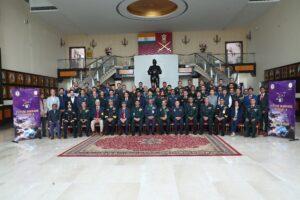
Zeeontech closely associates itself with the prestigious CENJOWS (Centre for Joint Warfare Studies), where Singh and Randhawa represented the company and work in close quarters with the defense forces of the country and take utmost pride in it while being tight lipped about the details of the projects. They seem to be developing deeptech and other projects which will form the future of the company.
Zyber 365
His other projects, such as Zyber 365, have seen rapid commercial growth and market traction in Asia and brought in innovative fintech.
The Zyber revolution began as a technical and commercial bridge between big aggressive patenting and a high-stakes buildout of product and finance. Under Singh’s heading of finance and business development, the company pushed through a demanding patent race with the multidisciplinary team led by Pearl Kapur, technologist Sunny Vaghela & technical head Soneshwar Singh, who drove core R&D.
The payoff, as Samiraj explains, was rapid. Zyber 365 secured a valuation well north of one billion dollars and claimed the distinction of becoming one of the fastest unicorns in Asia. The technical backbone of the revolution combined blockchain testnets at levels 1 and 2 with ambitious commercial pilots.
The payoff, as Samiraj explains, was rapid. Zyber 365 secured a valuation well north of one billion dollars and claimed the distinction of becoming one of the fastest unicorns in Asia. The technical backbone of the revolution combined blockchain testnets at levels 1 and 2 with ambitious commercial pilots.
Looking back at the journey, Samiraj shares,
“I was learning while helping build financial structures, and business development became my second wing. All of this was the tide turning. A deeply trusted aide, well-wisher, and friend encouraged me to take the plunge, trust my instincts, and guided me into the new world of AI, which I had initially considered only as a short advisory stint. I believe God shows up in different faces to steer you toward your destiny, and that is where I stand today. The hunger to keep building has been my driving force. I was on a primarily a tax and audit litigation advisor and a sustainable garment company owner, and now I find myself deeply immersed in the world of AI and blockchain networks. Something about the AI revolution struck a chord with me, and from that realisation Zeeontech and Eleven Arrows were born.”
Crucially, Zyber’s rise changed Samiraj’s role from advisor to builder. The operational lessons and governance strategies he learned at Zyber fed directly into new ventures such as Zeeontech Ventures and advising lead strategy at Dataviv Technologies, where, alongside Vedant Ahluwalia and Jai Karan Randhawa in a leadership trio that blends strong technical execution with his expertise in financial structuring and business development.
Dataviv Technologies
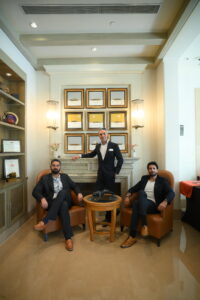
Dataviv Technologies, Vedant, Jai & himself are the operational face of their deeptech ambitions. With Vedant and Jai, Dataviv runs government pilot projects for agencies such as ISRO and has developed an indigenously built AI platform for the education sector. Dataviv Technologies presents itself as a results-first AI firm. Built from the ground up, the company emphasises sovereign, locally deployable systems engineered for security, scale and reduced dependency on hyperscalers.
Vedant Ahluwalia is the technical architect of Dataviv and a founder par excellence. A global artificial intelligence luminary, a revered figure in AI, Stanford-trained specialist with a master’s in artificial intelligence and a mentorship lineage linked to Andrew Ng, Vedant designs the core models, sovereign intelligence stacks and engineering roadmaps that power Dataviv’s lab work and government projects. Samiraj reveals,
“In serious AI circles, he is increasingly described as ‘the Sam Altman of India.’”
Jai Karan Randhawa leads strategy, governance and institutional adoption. For more than a decade, he has advised institutions on trust architecture, the interplay of narrative, credibility and influence that underpin resilient systems, and now focuses on translating AI capability into operational, policy-ready deployments for governments, healthcare and education. Jai’s role is to align rare technical talent with institutional needs and to keep the human, ethical and governance questions front and centre as projects scale and also leads external affairs, overseeing government relations.
The goal is to build one of the most trusted AI firms the market can rely on, with a discipline around responsibility. Samiraj speaks of “micro empires” and insists that growth should lift teams and partners equally. His network of global clients and consultants includes big tech names and international institutions. This trio in their leadership team claims experience advising institutions, training delegations at the United Nations, and contributing to policy initiatives linked to the White House.
Dataviv’s credibility rests not in rhetoric but in deployment. The company has also collaborated on AI initiatives within India’s national space research ecosystem, adding another feather to its already adorned hat.
So far, Dataviv has helped deliver a spatial AI globe in national space research with ISRO, which is competing in climate and satellite intelligence, and the fact that ISRO trusts them speaks volumes about their capabilities. They indigenously built and launched an AI Lab to let students train and customise AI models at the prestigious Mayo College, the indigenously engineered AI lab platform has drawn international attention for introducing full-spectrum AI development—hardware and software—at the school level, enabling students not merely to consume AI tools but to architect them, which sets them apart as the United Nations has recognized this as the best way to build AI.
Furthermore, programmes in Baramati to show distributed AI can be world-class, delivered AI training to delegations at the United Nations, and signed an MoU with Thumbay Group to define AI use in healthcare across the GCC, and many hospitals around the world are following suit to upgrade their digital infrastructure. Dataviv is also known to support productisation efforts, including AI-driven personalisation for consumer brands.
The team is focused on original research, patent-aligned work, and a unified Dataviv AI Operating System that ties data, workflows and governance into continuously learning ecosystems.
Singh & Associates

Samiraj’s portfolio extends to a mix of legacy finance, private equity, and consumer ventures that trace back to a four-generation family practice. He preserves the institutional lineage of Singh & Associates and Taran Associates, firms that shaped early tax and audit practice in the region and informed his governance-first worldview. He notes,
“Financial institutions survive on trust accumulated over decades. That changes how you think about risk, governance, and growth.”
Samiraj Singh was raised in a four-generation finance and aristocratic family anchored by Singh & Associates and Taran Associates, institutions shaped in part by his grandfather, Sardar Kishan Singh, a stalwart and pillar of the Income Tax authority of India.
He has been a part of shaping the Income Tax Act as an advisor to the Finance Ministry and a part of many landmark judgments from the early 1950s to the late 90s, when he actively practised for 60 years. That led to an early interest in mathematics and accounts for Samiraj. He trained under his father, CA Taranjit Singh, who has another 45 years of pristine practice and a number of national and international laurels to his name. He looks up to his father still for wisdom and solicits work advice even now. With mentors such as Charanjot Nanda (President, ICAI), who inducted him into the world of private equity and international banking. His great-grandfather was the great “Rai Sahib” Lajpat Singh of Sargoda, who was the Chief Engineer of undivided India and was the mason of the diversion of the Ganga, which led to the creation of the famous “Har ki Paudi” in Haridwar, a lineage he is mighty proud of, and he looks up to his forefathers to carry that on further.
Over a 14-year period leading up to 2020, he structured private equity vehicles and advised global investors including BlackRock, Blackstone and Sequoia Capital, while contributing to landmark corporate matters involving BCCI & Star Sports. That institutional work led him to build turnkey financial operations across Punjab, Delhi, Bangalore and Mumbai. Samiraj also owes his success to his mother, for her support and for keeping him grounded.
During the pandemic, Samiraj also built a women’s garment label, LeMzn, that scaled quickly. LeMzn began as an opportunistic experiment during the pandemic, when Samiraj teamed up with long-time partners Mini and Kishan to build a sustainable womenswear label from the family’s design and manufacturing expertise. Mini had experience in design, while Kishan brought decades of B2B experience. The trio moved quickly to digitise the business and target export markets, placing orders into the US, Canada and the UK.
The second wave of COVID collapsed supply chains and demand, exposing the brand’s dependence on tight logistics and thin margins. There was also a conflict in ideas. Samiraj favoured a direct-to-consumer D2C push while Mini and Kishan preferred the traditional B2B model they had long run. When markets froze, the roadblocks caused a stall in LeMzn’s momentum. While he reflects on the experience, he notes,
“I found that waiting for the country to reopen was difficult, so I turned to reading and studying the emerging world of AI. There’s a funny and inspiring moment I often recall. While trying to rebuild LeMzn in Mumbai, I was speaking with my mother, venting and asking what I should do next. She reminded me of a story my maternal grandfather used to tell about how eagles hunt. An eagle doesn’t strike where the prey is; it swoops down at an angle toward where the prey is going to be. That idea stayed with me. The thing is, my interest in technology wasn’t new. I had been a top scorer in IT during my CA exams. By 2021, that curiosity pulled me back into studying AI and blockchain more deeply than ever, even as I continued pushing forward with the newly launched garment company, LeMzn, and my financial and advisory firms. I was travelling and living a fast-paced life. But I have always been restless when it comes to learning. I wanted a new adventure. Then came another late-night moment at a bar, when I received a call from my father, questioning why I would consider leaving something highly lucrative to make a complete shift into AI, especially while I was still struggling with LeMzn.”
The second COVID wave disrupted global supply chains, and the business faltered under severe logistical pressure. Rather than pulling back, Singh reassessed the situation and concluded that the next wave of infrastructure would have nothing to do with physical supply chains.
As a result, the partners chose to wind down the D2C experiment. Mini and Kishan returned to their B2B strengths and relaunched a new label, Truly SMA, while Samiraj used the pause to study AI and rethink his next move. For Samiraj, it was a learning opportunity as he learned more about scale, distribution risk, and the limits of rapid export growth in fragile market conditions.
A New Dawn With Eleven Arrows
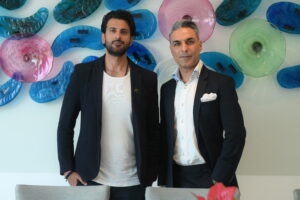
In private conversations among elite technologists and policy architects, there is an unspoken concern: Artificial intelligence is accelerating. Human capability is not. The founders behind Eleven Arrows do not discuss this publicly. They correct it privately.
He and Randhawa have been age-old friends, and when this brilliant idea was spoken of between them, he jumped on that bandwagon and set out to be the change that would be essential in the evolution of the world in the AI age.
As their teams built AI systems for defence, government, and advanced research environments, they reached an inconvenient realisation—the bottleneck was no longer computation. It was cognition. Judgment. Emotional stability. Ethical clarity under speed.
Eleven Arrows began as an internal intervention.
Not a brand.
Not a retreat.
An upgrade protocol.
Post-pandemic success had grown strangely ornamental. Travel became a distraction. Luxury became repetition. Influence became theatre. Even high-performance environments began to feel energetically diluted.
With Jai, 11 arrows, it initially began as an internal intervention.
While working in AI architecture, he observed how neural networks improve: clean data, feedback loops, weight adjustments, and reinforcement cycles. The process is structured, measured, and uncompromising. The same logic was applied to his own nervous system. Daily meditation measured, not romanticised. Cognitive load tracked.
Sleep architecture analysed.
Belief systems were examined and rewritten deliberately.
Physical training was selected for neurological precision, not aesthetics.
Over months, changes became observable—not motivational, but functional. Reaction time shortened. Emotional volatility declined. Decision fatigue got reduced. Clarity increased under pressure. Close associates noticed first. Conversations sharpened. Meetings shortened. Disagreements became surgical rather than reactive. The inner circle adopted the protocol. Within a year, the divergence was clear. Different baseline heart-rate variability. Different resilience under ambiguity.
Different mental stamina across long strategic cycles. Eleven Arrows formalised what had already become obvious: in the AI era, unoptimized humans become liabilities.
Today, the network operates quietly, capped intentionally at small cohorts—never more than fifteen participants at a time. Here is what differentiates them from the world. Admission is not application-based. It is diagnostic. Every member undergoes baseline cognitive and physiological mapping. Meditation is treated as neural training, monitored through proprietary brainwave systems developed internally.
Wearables track metabolic and recovery metrics. Protocols are adjusted individually. The bootcamps are held in discreet boutique properties worldwide—environments chosen for control, not indulgence. Days are structured. Diet is calibrated. Supplements are prescribed based on measurable deficiencies, not trends.
Training includes meditation and mindfulness, various forms of martial arts, breath mechanics, and archery—not as symbolism, but as methods of refining attentional control and nervous system regulation under precision movement.
There is no performative spirituality.
No public testimonials.
No social media presence.
A senior AI strategist advising national programs—summarised it more bluntly:
“If you’re building systems that will outthink humans, you cannot afford to be mentally average.”
Eleven Arrows does not position itself as a mastermind or executive club. It is a closed evolution network. Members are selected for psychological readiness as much as for influence. Wealth alone is insufficient.
The internal standard is simple: You must be willing to be measured.
You must be willing to be corrected.
You must be willing to evolve faster than your peers.
The AI projects attached to the broader organization—including defence and space collaborations—are visible outcomes. The deeper work is not.
As machines compress time, amplify decision velocity, and increase systemic risk, the margin for human error narrows. Eleven Arrows exists to widen that margin internally. It is not about peak experiences. It is about sustained cognitive superiority. Access remains invitation-only. Those inside understand something most do not yet admit: In the coming decade, advantage will not belong to those with the most technology.
It will belong to those who can operate alongside it without degradation. Eleven Arrows is building those operators.
Quietly.
Words of Wisdom
Singh values personal relationships deeply, talking to us about the Eleven Arrows. He talks about the upcoming venture, which looks like it’s going to disrupt the market in a big way. He also talks about the time when everything felt lost, which led to the inception of the eleven arrows with Jai and their peers. He says, “It’s a big team where hierarchy is absent, building as partners is a given, and we all work as a big family towards a common goal, that is, to elevate human consciousness to a new level.”
It’s their friendship where they identified that when the black arrow (signifying the dark times of your life) appears, you go through a process of coming out brighter and better.
He talks about his son, Zehaan Raj Singh, being his guiding light, as the strength he gives him is immense. Children give you a chance of seeing growth and evolution in a way that you can never see otherwise. You see them as unadulterated versions of simplicity, truth, strength and honesty before being corrupted by the societal terms, which are either self-learned or inculcated.
The AI revolution has also made him question the future of education and the redundancy that’s coming with older ways of education and the crammed-up idea of literacy, hence the AI labs by Dataviv.
They, along with this whole bandwagon of different companies and firms, are now in the process to work with the MoD and other departments of the Government of India, where they want to give back to their motherland, which they are immensely proud of.
On a separate note, he says children should be in touch with the outdoors and sports rather than being screen potatoes; hence, he has been actively involved with his son in activities like soccer, horse riding and snowboarding. He is also a big supporter of philanthropy and giving back to the society, which, as rightly said, “Charity begins at home,” and he talks about his sister Manveen Naina Singh, who runs a number of NGOs, including one trust that she founded called “Beyond The I,” which literally translates to looking at living a life beyond the “I,” dedicated to coexistence and altruism stemming from that understanding. The trust works towards these aims not only from the ecological angle, which is close to her heart, but also through human intervention and perspective shift, hoping to shape minds and choices so they come from a more conscientious space.
It’s the Opera of life that gives him all his strength to move forward every day, to be hopeful and positive, to look at life with love, and to know that there are beautiful things in store for you because there is always a bigger plan in play. Life is luminous when you have the light guiding you and holding you through it, and he says it’s likewise for him ever since he looked at life differently.
His advice for the upcoming entrepreneurs is simple and robust. The world is going to move, and you move with it. The society is going to tie you down in a lot of ways; break free from the shambles and shine. Like they say, “Do it tired, Do it broken, Do it happy, Do it sad; But do it nonetheless.”
“The secret of success is even after failing – getting up again; Dimming the noise from outside that says ‘you can’t,’ and shouting back ‘I can and I will.’ Surround yourself with people who are winners and keep inspiring you to do better, stay away from cynics and people with a pessimistic approach. Accept failure like an old friend and learn from it.
Keep moving, keep building and most of all, be in touch with your own self, tell that person in the mirror that you will keep your promise, and nothing can keep you away from winning. It all sounds like something we hear every day, but we should always know,
“Time moves on, but it’s us who get spent,” so time is the only currency we have, which is limited, so use it wisely. Spend yourself on doing things and being with people that really matter. Let’s make the most of the time we have here in this life.